mixed technique, mosaic's tecnique with recycled materials...
Critics


Dott. Pasquale Di Matteo
Our curatorial team carefully reviewed the exhibited works during and after the event, observing how each piece shaped the exhibition’s overall atmosphere and how visitors responded. As part of this process, we’ve prepared a personal reflection on your artwork – inspired by the same curatorial approach used during the exhibition.
During the Paris exhibition, your works left a remarkable impression, showcasing a unique blend of pop culture and artistic depth. In "Terminator," the bold use of metallic colors and the intricate mosaic technique evoke a sense of nostalgia while pushing contemporary themes. The dynamic composition captivates the viewer, drawing them into a narrative that resonates with both sci-fi enthusiasts and art lovers alike. Your ability to transform recycled materials into expressive visual statements adds a layer of richness, inviting a closer inspection of texture and form that envelops the senses. Similarly, "Ciao Mondo Dedicated to Mina" is a striking homage that masterfully balances emotional depth with vibrant color palettes, creating a vivid portrayal that transcends mere representation and speaks to the soul of the viewer.
Your work contributed beautifully to the diversity and quality of the Paris show. Throughout the exhibition, artworks with strong conceptual clarity and authentic emotional expression — like yours — consistently drew attention from visitors. Many stopped to take photos, discuss the compositions, and engage deeply with the pieces shown on the ARTBOXY Screens. This response confirmed how powerfully your art connects with viewers in a professional exhibition setting.
Across all exhibited works, our curators noticed several recurring strengths:
- Color and atmosphere – many participating artists used color with great sensitivity to convey emotion and light.
- Symbolism and storytelling – visitors were especially drawn to works that told a visual story or hinted at a deeper meaning.
- Technique and individuality – a strong sense of craftsmanship combined with authentic artistic voice made the exhibition exceptionally rich.
Your contribution helped shape that experience — thank you again for being part of it.
The ARTBOXY Curator Team
October 2025
Dott. Pasquale Di Matteo
THE SOUL OF ART
CARLA BERTOLI. POP ART THAT PORTRAYS IDENTITY
October 2025
Carla Bertoli’s art is a question mark hovering over the nature of the face in an age of infinite reproducibility and fragmentation.
Her artistic practice is not portraiture in the classical sense, but rather a critical inquiry—a near-surgical dissection of the facial surface, understood not as the mirror of the soul but as an ephemeral stage upon which the complex drama of contemporary identity is enacted.
Through a language that fuses the graphic impact of Pop Art, the emotional urgency of Expressionism, and a highly personal material vocation nourished by a grammar of found objects, Bertoli unmasks the mask, exposing the dense stratifications that constitute—and at times imprison—our sense of self.
Her vision deliberately distances itself from any temptation of imitation, choosing instead to depict icons of our time through which she lays bare the fabric of contemporary society. Bertoli is not interested in capturing likeness, but in interrogating the phenomenon of the face as a social, cultural, and psychological construct: what lies behind it, and what it represents.
Whether it is a pop icon like David Bowie, an archetype like the clown, or an anonymous visage, her gaze is never neutral. It functions as an instrument of analysis that fragments, isolates details, heightens chromatic tensions, and rends the surface to reveal the underlying strain. Her artistic persona is that of a sharp, disenchanted observer of the human comedy, acutely aware of the fragility of our masks and captivated by the dissonant beauty that emerges from them. Stylistically, Bertoli’s work is distinguished by an audacious and original synthesis. The foundation is often traceable to a Pop aesthetic, evident in the use of flat, anti-naturalistic color fields and crisp contours that define forms with graphic precision, as in her portrait of Marina Abramović. Yet this almost poster- like composition is systematically “contaminated” and complicated by diverse interventions that testify to the artist’s relentless experimentation in forging her peculiar idiom.
First, there is a chromatic and gestural Expressionism: color sometimes drips, collides, and blends impetuously, as in the clown’s face, where makeup dissolves into a mask of liquid pain. Second, the artist grafts onto the canvas heterogeneous elements—fragments of reality that erupt into pictorial fiction, generating a perceptual and conceptual short- circuit, a manifestation of her essential polymaterial impulse.
The shattered mosaic background behind Bowie’s face is not a mere decoration but a visual metaphor for a celebrity splintered into a thousand reflections by the culture industry and fan adoration. The gauze applied to the cheek of the woman in heavy makeup becomes a powerful disruptive element, superimposing a dressing, a sign of an actual wound, upon the artificial surface of cosmetics, producing a cognitive dissonance that probes the relationship between appearance and suffering, between cosmetics and care.
These recurrent stylistic strategies serve a broader program of deconstruction. Compositional cuts are often extreme, almost photographic, isolating the face from its context and forcing an intimate, sometimes brutal confrontation with the viewer. The gaze is a pivotal element: Bowie’s direct, asymmetrical look challenges and interrogates, while other faces lift their eyes heavenward in poses of ecstasy or supplication, or turn into profile, lost within an inaccessible interior dimension. Bertoli’s chromatic spectrum is bold, often electric: glacial blues, sanguine reds, acidic yellows, profound blacks. Color does not describe flesh tones but emotional states; it is psychological color, charting the temperature of the soul.
The semiotics of Bertoli’s work therefore centers on the theme of the mask and identity as performance. The clown is the most explicit archetype: his face is a battlefield between the cheer demanded by his role and the tragedy seeping through the drips of pigment. Yet for Bertoli, every face is a mask. Heavy makeup, studied poses, even the iconicity of a famous visage— all are forms of masquerade, roles assumed within society.With her painterly scalpel, Bertoli does not attempt to strip away the mask in search of a “true” face beneath; rather, she shows us that contemporary identity is the mask itself: an unstable collage of roles, images, wounds, and artifices, all sustained by the fleeting economy of images consumed within hours and valued according to the number of likes received rather than memories or ideals they inspire.
Thus Bertoli succeeds in transfiguring her chromatic syntax into a profound reflection on the fragile and constructed nature of our being-in-the-world. The emotions she elicits are never straightforward, but invariably ambivalent: admiration and pity, fascination and repulsion, glamour and decay.
The philosophy that emerges from this inquiry is unmistakably postmodern. If classical humanism envisioned the face as the locus of individual truth, Bertoli represents it as the locus of representation— and often, alienation. Hers is a vision that embraces complexity and contradiction without seeking facile syntheses. The relation between her art and emotion is always mediated by a lucid critical intellect; passion is evident in gesture and color, yet it is consistently governed by a precise analytical intent. There is no lyrical abandon, but rather a constant tension between the impulse to express and the will to propose meaning.
Carla Bertoli is one of the most original and necessary voices on the Italian art scene, for her artistic practice transcends portraiture to become a form of visual essay on identity in an era of rampant identity crisis. Through a hybrid language that contaminates the purity of painting with the concreteness of the object, she compels us to look beyond the polished surface of images and to confront the complex, stratified, and often wounded nature of what we call the “face.”
Her canvases speak to us, revealing our own human condition.
Pasquale Di Matteo
International critic, Writer
Dott. Pasquale Di Matteo
Crema, May 2, 2025
In Carla Bertoli’s pop-infused universe, art is no longer mere representation - it becomes an archaeology of interiority.
Her work doesn’t just question the human condition; it dissects it, tracing its emotional fault lines and transforming each canvas into a visceral confrontation between the visible and the invisible.
When Bertoli paints a face, it is not a portrait but a battlefield - where identity and mask collide, leaving behind scars that speak their own language. She does not paint in the traditional sense; she excavates, with the methodical fury of someone who knows that truth hides in the cracks.
Her technique is a living oxymoron. The chromatic and gestural applications - marked by violent contrasts - echo the urgency of De Kooning, yet with an existential charge. What emerges is not the unconscious, but consciousness itself, torn and raw from life.
Her figures, twisted to the point of anatomical dislocation, defy classical canons. They evoke Francis Bacon, but tempered by an unexpected compassion. The eyes, stretched wide, are not windows to the soul - they are black holes that destabilize the viewer’s gaze, compelling us to confront ourselves within the void.
Her color palette embodies the philosophy behind her vision.
Bertoli turns the canvas into a palimpsest of memory, where layers of paint are scraped, erased, and unearthed. Beneath the ultramarine blue of an apparently serene sky, ghosts of dirty white emerge - residues of past suffering.
Bold contrasts and visible fractures become metaphors for the psyche: the smooth surface is a lie; the true essence lies beneath - in the magma of unresolved emotion.
The regenerated materials she incorporates into her work are not mere mediums - they are witnesses, much like in Anselm Kiefer’s practice, where lead and ash preserve collective memory.
For Bertoli, vulnerability is not a flaw, but the only true act of authenticity in an age of filters and fluid identities. Her art does not aim to console - it aims to disturb, to force us into confronting the ambiguity of being both fragile and indomitable.
In an era of digital oversimplification, Bertoli is a radical countercurrent. Her works are not simply paintings - they are mirrors reflecting the constant negotiation between the performative self (social, acceptable, influenceable) and the authentic self (chaotic, wounded, free).
Her lineage aligns with Frida Kahlo in the way she transmutes autobiography into visual form - but with a postmodern signature: there are no self-portraits here, only acts of collective self-revelation.
In a world obsessed with appearances, Carla Bertoli reminds us that true beaut - human beauty - resides in imperfection and silence.
Pasquale Di Matteo
International critic, Writer
Pasquale Di Matteo, Art Critic
L’ELEGIA DELLA VULNERABILITÀ
Carla Bertoli reconfigures the DNA of Pop Art through a contemporary sensibility that merges the aesthetics of consumerism with a material archaeology rich in ethical implications.
Her practice, oscillating between cultured citation and experimental innovation, transforms the pop language into a critical device for questioning identity, ephemerality, and the contradictions of a hyper-permeable society.
The faces, marked by almost violent chromatic contrasts, become existential masks that convey the conflict between the urgency to appear and the desire to be—between the homogenization of global taste and the search for an authentic self.
The use of reclaimed materials elevates her work to a manifesto of an aesthetic of reconversion.
Here, Bertoli embraces a philosophy of regeneration in which every object, rescued from the cycle of waste, acquires a second life as a narrative element.
This practice is not just an ecological act but a symbolic gesture that overturns the consumerist logic of historical Pop Art: if Warhol celebrated the seriality of the product, Bertoli unmasks its transience, transforming the remnants of capitalism into emblems of resilience.
Her reflection on the “liquid society” is embodied above all in archetypal figures that become allegories of contemporary ambiguity.
The clown, with its hyperbolic smile and gaze veiled in melancholy, embodies the dichotomy between appearance and substance, while the women—portrayed with a monumentality that evokes secularized sacred icons—challenge gender stereotypes through a femininity that interrogates rather than invites contemplation.
In these works, the artist carries out a semantic reversal: pop glamour becomes a tragic mask, and decorativeness becomes a lens through which to explore discomfort.
Bertoli builds a bridge between the immediate allure of visual culture and the depth of artistic engagement.
Color, a cornerstone of her lexicon, functions as a dialectical device where fluorescent tones—drawn from Pop culture and reinterpreted through a neo-expressionist sensitivity—are not mere decorative explosions but emotional force fields.
The contrast between acidic hues and earthy gradients, between artificial fluorescences and organic shadows, generates a perceptual short circuit that reflects the dichotomy between the individual’s vital energy and the systemic chaos surrounding them.
Pasquale Di Matteo
International critic, Writer
Pasquale Di Matteo, Art Critic
Text in Japanese
April 2025
Carla Bertoli’s art is where Pop Art meets material innovation, a space in which an original, bold visual language, deeply intertwined with contemporary dynamics, comes to life.
Carla Bertoli draws on the legacy of pop tradition, with its vivid colors and the iconic quality of its figures, to reinterpret it in a personal way.
The human face, often the absolute focal point of her works, is never a mere photograph but rather an open window into human identity and the culture of our time.
Facial features are accentuated, deconstructed, and reassembled in a play of saturated hues and chromatic contrasts, endowing her subjects with an almost magnetic intensity - as if their faces were proclaiming their presence amid the visual chaos of the modern world.
Carla Bertoli is meticulous about the conscious and refined use of reclaimed materials, which become an integral part of her message. The choice of these materials is far from random; it underscores an ethical and symbolic urgency: to recover is to reanimate, to reinvent the past in order to build the present - an exemplary gesture for all.
She creates a bridge between the fleeting nature of consumer culture and the profound cultural depth of the artistic gesture. This is achieved through a deeply personal vision of color, presenting faces that reflect on our liquid society, where identity is perpetually in flux, poised between appearance and substance, just as is evident in her abstract style.
In Carla Bertoli’s art there is a constant tension between beauty and unease, between comfort and torment. The face of the clown, female portraits, and other iconic figures serve as symbols that upend expectations, inviting viewers to question what is authentic and what is merely constructed.
Carla Bertoli’s innovative strength lies in her ability to merge the visual impact of Pop Art with a profound reflection on society and our time.
Pasquale Di Matteo
International critic, Writer
Pasquale Di Matteo, Art Critic
Roccart Gallery Florence
April 2025
Carla Bertoli’s Art: A Scalpel to the Masquerade of Modernity.
Carla Bertoli’s art is a surgical act performed with brushes and palette knives, an investigation that transforms the canvas into a battlefield where identity and mask engage in relentless combat. Her work serves as a magnifying lens on the paradox of contemporary humanity, suspended between the urgency to exist and the compulsion to self-represent. Here, the face is not a portrait but a map of symbolic wounds, a terrain where the drama of lost authenticity plays out.
Bertoli dissects the world’s hypocrisy with the precision of a cartographer of the invisible, charting routes through the fissures of the collective psyche. Her works act as distorting mirrors, reflecting an image of reality more truthful than reality itself. The mask is no mere metaphor: it becomes the only viable face in a society that rewards performance.
Her colors are poisons neutralizing one another; the artist seeks not harmony but chromatic friction, shocking pinks colliding with toxic greens, oranges detonating against leaden backdrops. This palette does not describe emotions: it detonates them. The violet of a cheek is not shadow but metaphysical bruising; the white of eyes not innocence but the void of those adrift. Even her sparing use of black transcends elegance, becoming a singularity that devours identity.
Bertoli constructs an alphabet of disquiet, where material itself morphs into symbol: oils drip like existential sweat, acrylics congeal as scars, collages evoke shreds of stolen selves. Her vision is fiercely contemporary yet rooted in uncompromising existentialism. Her work poses a visceral question: What remains of the human when every gesture is performance, every relationship curated like a social media profile, every emotion filtered through algorithms? Her figures drift through indeterminate spaces, untethered to time or place-ectoplasms of a rootless humanity.
Her art unsettles like a psychoanalyst dismantling our cherished lies. In an age of selfies and augmented realities, her distorted visages remind us that identity is construction, negotiation, betrayal. To engage with her work is to confront one’s reflection after a sleepless night: no filters, no makeup. We emerge vulnerable, fragmented, grotesque. Yet within this crumbling, Bertoli sows a paradoxical hope: only by acknowledging our masks can we begin to seek - however futilely - what lies behind them.
Her painting, ferocious and essential, issues a warning: In a world demanding we become icons, let us not forget we are also pain, error, doubt. Imperfection. For it is there, in that tragic margin between laughter and scream, that humanity may yet survive.
Pasquale Di Matteo
International critic, Writer
Pasquale Di Matteo, Art Critic
November 2023
With her peculiar interpretation of Pop Art, Carla Bertoli leads us into a world of nostalgia and reverence for the people who have shaped the collective consciousness of the past.
The artist reworks pop culture icons, from the faces of celebrities up to unforgettable cartoon characters from the 80s.
Every detail evokes a powerful family feeling, memories, past experiences, emotions.
But the thing that puts Bertoli into another league is her capacity to go beyond mere visual reproduction: she transmits the essence and all detailed concepts conveyed by such characters.
Her artworks build a bridge between different eras, where past prominent personalities come to life again in a new and vivid way, evoking a sense of continuity in time.
These familiar faces become connections between generations, witness to a period when the world was a place of unity and adventure, without barriers and discords.
Indeed, the cartoons of the 80s, with their heroes defending the world from alien species, return in Bertoli's artworks in a lively way; they remind us that mankind can act as one, without taking heed of divisions and distinctions due to ethnic or cultural differences.
These characters, who once were a source of inspiration and hope for a whole generation, are transformed into icons of strength and resilience, to fight against the modern world's lack of direction. The cartoon characters represented a world where unity prevailed over differences, where humanity was the force that triumphed over hardship.
Cremona 19th November 2023
Pasquale Di Matteo
International critic, Writer
Pier Antonio Trattenero, Art Critic
June 2021
I got to know Carla Bertoli's art through Facebook. I do not write to express
a judgment but to comment on a sentence of P. Di Matteo:
"Her themes are double linked to popular culture, but Bertoli's poetry is elevated
by her philosophical stance, thanks to which she develops themes that can be connected
to the effort of living." Finding an artist who is able to interpret these concepts in his/her
artworks is rare nowadays; the popular culture, the distress of living.
The link to a concept expressed by M. Heidegger, according to whom a life full of significance
is possible only by overriding triviality, is fully internalized by this painter who has the guts
to go beyond and consider the environmental theme. Di Matteo recognizes in her the addition of being
an artist fully living the present - the art exceeds the dimension of time in its
physical and phylosophical meaning, in order to conceptualize itself in the dimension of the present
being painted on canvas, not restraining it in but giving it back dimension in its appearance,
between original chromatisms and personal intuitions that feed the art.
Carla, I cannot add anything to those who interviewed you, they are good at it and have avoided
any attention-seeking behaviour, leaving you the proper space. I only say that your art is a
walk along the magical paths of knowledge, you stop to enjoy a flower and you realize that you had already
envisaged that flower, you ask yourself where, in a town, choked by waste. Thus, you rendered it visible
and transformed it into a female face, a suffering face, a face cut down just like the flower.
You have figured out its secrets and, silently, you have bonded. The artists' silence does not
have words, it has acts of compietas, it does not ask, it gives.
May your art nourish itself with silence, a silence crying out to mankind
that such path is still long but that the artist is already prepared to walk along it.
Carla Bertoli Art and Self Representation
How hard is it to outline the self-representation capacities of an artist like Carla Bertoli?
It surely is demanding. When you think that the attempt was successful, she slips away
and reappears transformed. Maybe this is the concept defining this gifted artist's painting.
She is influenced by pop art but reinterprets it and it is not an ordinary interpretation.
Self-representing means putting one's being at stake, transferring meanings on canvas with
the risk of not being understood. Maybe this is the artist's drama, to act in order to break
the silence and shout out her essence to the world. Tragedy? Maybe not! But invocation to be.
First of all, Carla talks to herself, the only way to communicate in order to be credible.
Therefore, her artworks ooze genuine existential questions, secrets if you want, but revealed by her art.
The vision of a credible and sustainable world, the recovery of matter as a way out of the refusal
of living authentically, the very evident chromatisms in order not to be veined by silence.
And everything glides fluently, everything connects to offer food for thought and new perspectives.
You do not need many words to render her justice, you need to stop in front of the artwork, talk to her and then,
a bit altered, smile at her and say "This time it's big trouble, you induced me to think."
In a world that has stopped thinking, let us rely on the magic of her art.
A critic who does not criticize, Pier Antonio Trattenero.
Art Critic Pier Antonio Trattenero. June 2021
Pasquale Di Matteo, Art Critic
May 2021
Carla Bertoli is an analytical observer of her time: she is able to single out the essence of things,
and sensations, emotions and feelings that arose from her analysis are turned inside out on her canvas.
Carla Bertoli is an artist winking at Pop Art, with a personal vision of colour and composition.
Her themes are double linked to popular culture, but Bertoli's poetry is elevated by her philosophical stance.
Women come up often in Carla Bertoli's representations, common people, other times famous people;
however, the artist possesses the capacity to catch them in self-explaining expressions that reveal their soul.
An artist whose peculiar chromatic liveliness tells about our time, with a special focus on female emancipation,
on the discomforts of the weaks and the needs of youth.
Her Pop Art is a slap sounding an alarm, waking sleepers and silent ones better than a thousand words.
Carla Bertoli has a special attention for the environment, so much so that her artworks are composed
of recycled materials that the artist puts together and paints like a puzzle, using her peculiar approach to the mosaic technique.
Carla Bertoli is an artist who is able to tell about her time as just a few are, and is a valid expression of Contemporary Art.
Carla Bertoli is included in the first volume of I VERI ARTISTI CONTEMPORANEI (The True Contemporary Artists), by Pasquale Di Matteo. May 2021
Pasquale Di Matteo
NEW ARTISTIC POLYPHONIES
Anna Maria Stefanini, Journalist
March 2021
The appearance of the artisanal workshop, followed by the artistic atelier
(the one where e.g. Giotto, Leonardo, Raffaello studied) has represented
an actual archetype change in our antropological curve: the victory of talent and creativity on raw matter.
Carla Bertoli follows the path and frees her creativity infusing her artworks
with intense polymorphisms and polychromies; the same syntax is reached
by Carla starting from matter in its most elemental states.
Pigments, forms and surfaces to be tampered with, just as the minimum sematic units of a text.
The result of the intention is a stereometric glance using divergence in order
to grant evidence to the individual artistic style of great substance.
Carla Bertoli works with raw matter and creativity, in different ways but with a single meeting point.
Anna Maria Stefanini
Pasquale Di Matteo, Art Critic
Carla Bertoli’s art is a continuous stylistic research where painting meets
mosaic and where the two dimensions take on material applications, mostly
parts of recycled objects, all the way to disclosing new geometries and
different dimensions. With a mixed technique that merges research, culture,
painting and a modern take on mosaic, Carla Bertoli converts the use of
recycled materials into an artistic form, uses recycled elements with the
mosaic technique and turns them into pictorial and volumetric pieces that
compose the parts of the support in 3D.
THE POP ART FRONT
Carla Bertoli expresses a great deal of herself through all her works; with
Pop Art the artist grants a particular attention to the visual field,
seeking hidden expressions, untold secrets, stories that would deserve
better luck but, due to the limited listening capacity of the sense of
vision remain muted too often, in the alarming indifference that is the key
player of our times.
By means of her artistic expression, Bertoli feeds the wish to unveil, that
curiosity being the foundation of every invention.
And the object of experimentation by the Lombard artist is, without any
doubt, the human being with its thousand facets; the evocative framings that
distinguish most of Bertoli’s Pop Art portraits are indeed the symbol of her
research, where she isn’t simply a painter but a detective of the soul.
Eyes that tell tales, facial expressions lacking only exclamation marks, are
none other than the legacy of a communication path that Bertoli aims for,
not so much to master a refined style but to explain to the world that human
beings are social animals and that they absolutely need one another not to
be useless.
Therefore, Carla Bertoli invites us to give greater attention to the others,
to those who surround us, suggesting not to stop at a casual glance, because
the sense of vision is hardly able to elaborate something capable to go
beyond and overstep the top layer of image.
With her oeuvre CIAO MONDO, dated 2014, Carla Bertoli strengthens her desire
to burst through the superficiality of image, in order to reach the depth
and substance of people.
In this tribute to Mina, the artist focuses her attention on a star who, at
the peak of her success, decided to move away from television, from that
world of image towards which all others were running.
Such decision certainly did not detract from the popularity of the great
singer and has not in the least limited her success; on the contrary, the
veil of mystery woven around this celebrity had on one side the purpose of
keeping a contact with her fans, and on the other side allowed the most
famous Italian singer to take back control of her life.
WOMEN, INDIVIDUALS, STARS
Carla Bertoli nurtures a particular attention for the female world with its
contradictions, its history, the emancipation, the abuses, the violence, the
sensuality, the femininity, in a kaleidoscopic world of colours through
which Bertoli tells us about, and glorifies, the importance of women in the
world. Ordinary or important women, international stars or unknown
characters obtain the same space and the maximum respect in Carla Bertoli,
in the refined quest for inner depth, repudiating the shallowness of image.
OBAMABURGER
The metaphor of the hamburger, the greatness of humility. In her constant
tale of the present times, Carla Bertoli seems to be attracted by
significant episodes that fall outside protocols, rules, schemes of a
contemporary society where there’s a great deal of talking about
emancipation, altruism, equality, but where too often the pathos-laden
conversations are not followed by tangible facts.
Quite the opposite, we live in times where the disparities and segregation
into social strata are more marked than ever.
Thus, when Barack Obama tears down restrictions and traditions that should
impose a series of actions to a politician of such degree, and allows
himself a break in a fast food court, Bertoli immediately succeeds in going
beyond the image, fully investigating the fact, analysing it, and then
expresses the media power of the message through painting.
Bertoli is able to pin down the power of the hamburger metaphor, of the
great politician who is human, serving ordinary people and not only the
mighty, those who go to luxury places.
It’s exactly this capacity of Bertoli to catch the nuances that make her an
attentive narrator of our times.
THE SHATTERING POWER OF HUMILITY
Treading the same pathways of some great masters of the past, Carla Bertoli
makes her own the pleas of the last ones, of the people on the fringes of
society, of the humble ones nobody cares about.
In fact, the artist reveals expressions and feelings of ordinary people who
become main characters, just as in other works where famous characters are
shown.
After all, Bertoli always focuses her attention on aspects that are more
in-depth than simple fame, rendering humility and normality her favourite
themes, through which the artist succeeds in expressing on canvas her soul
and all the concerns that well up inside her from the sheer act of living.
GREAT ATTENTION FOR EYES AND THE ANIMAL WORLD
Beyond nurturing the desire to give the last ones more space, Carla Bertoli
shows in a remarkable way her vision of the future, hoping for an increased
attention for animals, in a mankind and environment dualism where all living
creatures shall be respected.
Thus, Bertoli uses the eyes to observe with the heart.
THE FASCINATION FOR COMICS
Another artistic theme of Carla Bertoli is the one dealing with portraits of
heroes from comics, those series of a forgotten past that have been replaced
by other stories.
They said that those episodes were violent and too sad, but today we become
aware that they have been replaced by a great number of inappropriate and
vulgar cartoons, unable to create that empathy that we built with the heroes
who steered the robots with which they saved the world.
Through her works, Carla Bertoli proposes those times again, taking those
heroes, whom the children would need, back to life, romantic characters full
of values who have been replaced by electronic devices and the cold
riskiness of social media.
With this series of oeuvres, Bertoli promotes the rediscovery of values and
feelings that the young ones are no longer able to experience, since they
are stimulated by other things.
The bond, the love, the fight for a common feeling, the grouping together to
defend the identity of a society – today all this has been replaced by the
celebration of a personality, of individualism, of attention-seeking
behaviour at any cost.
Once, the kids were dreaming about saving the world from the evil ones, just
as the heroes that steered the robots or those who had superior capacities
that they used for everyone’s sake, even risking their life.
A romanticism and a depth replaced by the “like” obsession on the social
media and by the paranoid desire to appear at any cost, crushing all others,
that binds the young people nowadays.
Carla Bertoli is an authentic storyteller of our times.
Milan, October 2019
Pasquale Di Matteo
Franco Rotella, Studiorotella's Art Director
Carla Bertoli’s artworks that succeed in involving emotionally are certainly those that Carla identifies as Pop Art.
The hypnotic gaze of "Valentina" in a softly elegant close-up construction, in a juxtaposition of red and black,
proposes and joins hot and cold of perceptive matrix, typical of this character’s nature.
In "Sensual Smoke", the diagonal logic of the whole amplifies the dizziness of the act, in a condition of material and existential worn-out state, almost a message of death.
In "Thinking of You" the positioning of the building blocks, modulated in a fluctuating view, seems to communicate the need to be one with the other,
completely, as if to possess him or her not only physically but emotionally.
I believe that Carla Bertoli has to continue being there in this quest, as she seems to live it as the essence of her very existence.
Naples, January 2019
Franco Rotella
Elena Ferrari
Carla Bertoli’s Art
By Elena Ferrari
January 2018
Art flows strongly in Carla Bertoli’s veins thanks to her great-grandfather, a capable wood carver and her father, a goldsmith artist.
From here springs her love for art, beauty and culture.
Among her passions we count also the love for semiprecious stones and crystals, from where she draws inspiration to implement her growth and change, triggering inside herself a consequential introspective motivation.
Her oeuvres reflect her good taste and an incessant quest for innovation.
This has led her to personal studies on experimenting the use of second-hand and recycled materials, placing them side by side or mixing them.
The goal is creating new visual and tactile sensations, in particular, taking the risk of proposing complementary or contrasting elements in her artworks,
thus awakening the observers’ curiosity and capturing their attention completely.
The artistic path followed by the artist has led her to favour portraits. Faces represented with unusual framing angles are lit up and enhanced by the vivid colours of Pop Art.
Faces, or maybe hidden souls. Everyone with a different story to tell. Or secrets to hide. Every detail has rich meanings.
Every colour or shape holds the need to be in that exact position, as if they were many small mosaic tiles, set inevitably in their place.
For Carla, art is a metaphor, where every face sees the light and takes on shape mainly to know herself, basing on philosophical theories focused on introspection and the search for oneself.
Milan, January 2018
Elena Ferrari
Gianni Turina, Member of Parliament
Meeting Carla Bertoli and her art, exhibited at the festival "L’Arte oggi nel Regno Angioino" ("Art today in the Angevin Empire") held in Cittaducale,
represent an important opportunity to review an articulate and complex artistic path.
Her personal exhibition, set up in the show hall at Palazzo Maoli, highlights a contemporary pictorial language rich in technical expressions,
where she absorbed the heritage of her grandfather, a wood carver, and her father, a goldsmith and artist, and modernized it.
A never-ending research that finds inspiration in famous people, whose portraits are used to send social messages and evoke emotional moments loaded with creative energy; also,
the reuse of waste materials grants the opus a historical liveliness.
The portraits are realized with a peculiar photographic cut and express enigmatic ways of being and communicating;
all of them show a subtle irony, as if she wanted to dispel particularly complex situations and moments.
Carla Bertoli expresses herself in a dynamic way. Her artworks are a constant experiment in technique and language,
sourced also from her experience in mosaic and her cultural relations.
Her presence at Cittaducale will allow visitors to enjoy evocative artworks that need to be discovered in-depth, and will strengthen the discussion on new art trends.
Cittaducale, 10th June 2016
Gianni Turina
Elisa Bergamino - Journalist, Art Critic
June 2016
Carla Bertoli’s world cannot be accessed in a hurry or inattentively, while focused on other thoughts.
Her art is a sacred place where one enters silently, with no haste and willing to listen. In every face she paints we perceive modern society, our time combined with the past and looking out to the future.
Thus, past, present and future fuse together; poetry and utopia lead the public to explore a universe unknown to most, a universe able to seduce even the strictest observer.
Carla Bertoli’s artworks are the result of a long analysis process thatstrives to express the meaning of a reality having its deciphering key in the depicted faces, in the light and in the colour.
The artist infuses them with her own world, a deep lyric poetry made of intimism and awareness.
The artistchooses to paintsubjects who somehow are her alter egos. Portraits representing mostly women, individuals of her time, often shown from a realistic angle.
Faces with determined, authoritative or melancholic features. Features describing strong characters, a desire to achieve, impetus, courage. Or else... seemingly indecipherable characters, refined, sensitive, seductive.
Portraits that breathe the same air as the one painting them. It is therefore easily perceivable that their creation constitutes a sort of introspective journey of the artist herself.
Many have already talked in due detail about Carla Bertoli’s art and painting techniques; therefore,it is essential to focus on the intuitive and conceptual contents of her artworks.
Faces that abstractly stare at the void, the thinking is internalised. Bertoli’s art starts always from the acknowledgement of reality, giving us back the marvel and the blues in a relentless diary by images,
becoming a memento for our condition of humans and modern beings. Compositions created with a moving passion, showing the emotion and reason she puts into her painting.
Creation is a real need for Bertoli, not just a merely decorative "time", but translates into the realization that her thinking cannot rely only on images:
enter intuition, that investigates the collective unconscious and produces an aesthetic language mirroring our poetical archetype.
This allows us to face the artwork with the purpose of touching the observers and awakening them to awareness while they discover the concept of the artwork and of the poetical content that succeeds in moving them.
Giorgio Falossi
Carla Bertoli:
PSYCHIC TONE'S REGISTER
Art Historian
July 2012
I had the chance to see some of her oeuvres on the Internet. A remarkable research work, especially on the body shape where form takes on several textures and colours,
giving mysterious concepts to the human being.
Body shapes are always in relationship with the environment, the cosmos, nature, in a conceptualism that stretches from ethical to social, built on a strenuous connection of fragments,
segments, soft colour sets. Here we have a solid but elaborated form, a material but spiritualized form, a range of psychic keys that starts from the emotion and takes form in fantasy and discovery.
Carla Bertoli humanizes instincts and needs, focusing her artistic quest in a never-ending human path, with a symbolic backdrop of reality, and I would add also of truth and freedom, necessary to render a work an artwork.
Giorgio Falossi
Guido Folco Art Historian
Carla Bertoli:
The Spirit's Matter
July 2011
How can we avoid thinking that art can also - if not exclusively - challenge modernity, time and immortality?
Carla Bertoli’s artworks are a contemporary example. A brave interpretation of a language by using images, signs and colours, thus universal and eternal in its immediate perception.
The artist looks at the world, the passing of time, the changing of history and its main characters, more or less famous or of daily and familiar closeness and sketches their spirit in a formal and chromatic bodily dissolution.
Carla Bertoli’s oeuvres are a metaphor of human existence and seem to ask the observer about the sense of life and the never-ending conflict between spirituality and physical world.
The intense colour, the use of superposing materials achieving tri-dimensionality, almost a mosaic sculpture, affirm a material texture of being, inquire about its essence but, at the same time,
the author’s action dissolves into the dreamlike vision of the subject that seems to escape anatomical rules to flake apart into reverie and imagination.
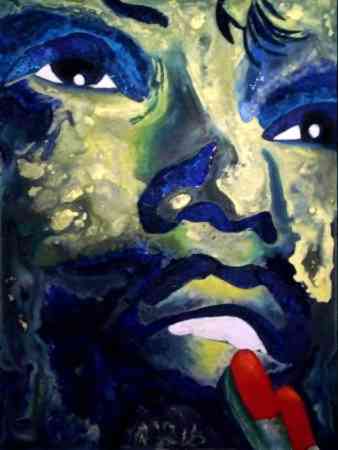
In Carla Bertoli’s varied world, celebrities who became icons of our time find their place. The artist has dedicated remarkably intense oeuvres to them, as an homage to life and ideals.
Click to zoom
Click to zoom
Click to zoom
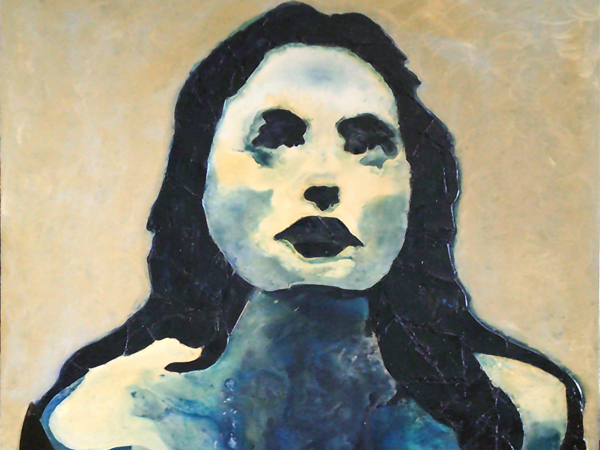
For instance, the artwork titled "The Silence of Marina Abramovic", centred around the Serbian author born in Belgrade in 1946,
who became famous for her installations that create a tight dialogue between artwork and audience, between body and mind.
In this portrait of the author, Carla Bertoli performs a semiotic operation on the being, interpreting the body as "container of emotions".
The unreal and contrasted colour, between blue and black, outlines more psychological than physical traits, letting energy and intense drama flow.
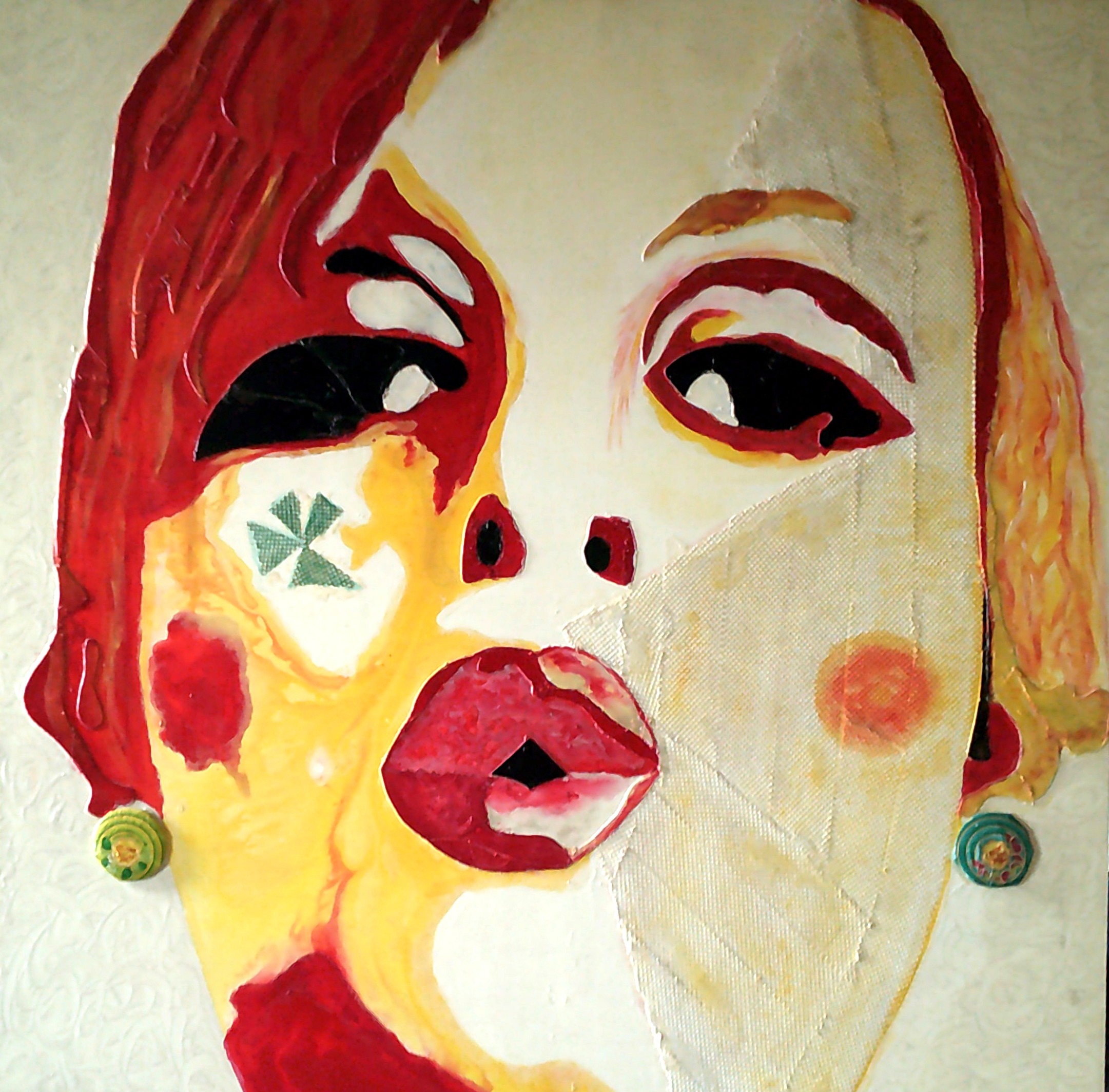
Also "Twiggy Forever" reveals new approaches and interpretation viewpoints.
In Carla Bertoli's artworks, several focus points concentrate the observers perception and induce them to explore a chromatic universe that goes well beyond a traditional representation.
Eyes, lips, jewels, cheeks: the face of the British model is represented in its essence of modern icon, with a subtle play of unveiling reality, transforming the truth into fantasy.
In a positive-negative photographic contrast, the face assumes a role of communication tool, a subliminal and media message.
Pop culture transforms characters into myths or, conversely, the former transform art into a mirror of the times.
In "Reflection" Carla Bertoli retrieves her family tradition and her creative education: daughter of a master goldsmith who has exhibited for the company "Cusi" of Milan at the New York Moma in the years 50/55,
Carla Bertoli breathes in art, good taste, beauty right from the start.
Among her passions there is also the love for semiprecious stones and crystals, from which she draws inspiration in order to transfer energy, interaction, communicability.
Thus, the artwork reflects also the culture of ancient times and of innovation, as research and risk in proposing complementary elements that are however far from one another as concept and culture.
In this dualism between body and soul, in her symbolic vision of representing the reality and the imaginary, the human and the divine,
Carla Bertoli creates the premises for a wise and educated art that holds the past in mind in order to face the present and the future.
You do not find traditional mosaics in her oeuvres, but chromatic fragments of unrestrained, globalized life, assembled in a symbolic melting pot of life tiles, between history and personal perception;
not mystical icons but enigmatic faces that open internal worlds; not monumental frescoes but paintings celebrating everyday life with the intensity focused in the gaze, in a detail that becomes universal.
In the epidermal metamorphosis of the portrayed subjects, the substance of pigments and painting seems to have a will to change, to deeply transform the essence of mankind,
elevating and transfiguring the misery of our existence with a spiritual breath that we could define as metaphysical, in its desire to detach from flesh, from reality, from life, from time, sublimating pain, joy, emotion.
Also for this reason, Carla Bertoli's art assumes a dialectic cross-cultural value, disclosing new interpretation paths that are unconventional and isolated, original in their extremely personal view of being.
Guido Folco
Raia Nunzia, D.M.A. - I.S.A. Monza
January 2010
Introducing the artist:
Carla Bertoli was born in Milan on 1st August 1963.
Since early childhood she shows a remarkable penchant for good taste and an aesthetical sense, a quality she will use in the following years in several artistic forms.
Born from a father designer of jewellery, in the course of the years Carla Bertoli acquires, grows and achieves an affirmed and deep dedication to studied and elaborate art,
revealing herself with totally innovating, egocentric and particularly complex artworks.
An artist decidedly on the rise and with an undisputable physique du role.
Click to zoom
Introducing the artwork:
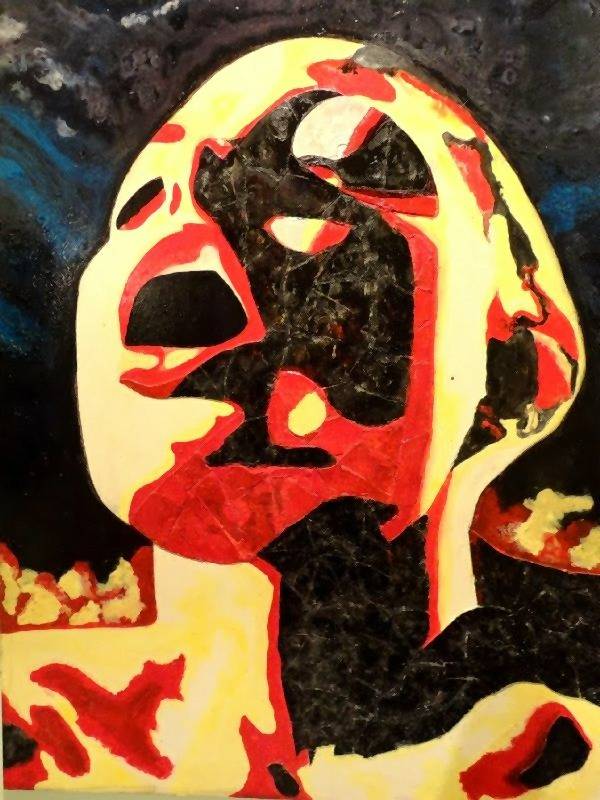
Untitled - dedicated to Angelina Jolie
80 x 100 cms - mixed technique
Year 2009
The taste of fall comes to mind, scent of dry leaves fallen on a meadow, soft wide sunsets in the sky, then enclosed in a dark blue note...
The warm and vivid fragrances of bright red, perfectly bonded to softer and elegant essences in shades of blue, render this artwork unique and unparalleled in its genre.
It will be obvious to the eyes of anyone who observes this artwork using their soul: the purity of white tied to the cheerfulness of yellow, embraced by the passion of red joined with the aggressiveness of black...
All enclosed in a candid sky blue note.
Neutral and primary colours that with attentive working and mixing create a visual effect of absolute perspectival perception, that undoubtedly increases if one looks at it from a wider visual angle:
both the use of colours and of materials render the artwork a place where the idea of space/time tends to abandon to itself, taking the observer into a dimension of surreal but "consistent marvel".
The technique used by the artist has been progressively refined, increased and ripened during the years, until it reached a high and definite sense of fulfilment both in the skilled observer’s and the amateur’s eyes.
Personal opinion:
I had the honour and pleasure of witnessing her artworks while she worked on them, while they evolved and were completed. A tidy, precise artist who respects the deadlines of the art galleries.
But also a unique artist, dynamic, extrovert and heterogeneous, able to adapt herself to the more complex requests of today’s art market. An artist and a woman, can there be a more suited symbiosis?
As a woman, Carla is always able to touch me, to touch us and to awe us due to the maternal, almost obsessive love she uses giving birth, nurturing, growing and feeding her little big artworks.
Just as a loving, anxious mother demands the best care for her children, Carla gives all of herself to her art, passing hours upon hours in her studio, a place where some of the most beautiful oeuvres of today’s market come to life,
that are fascinating beyond words.
I believe Carla Bertoli is a complete and all-over mature artist.
Cuono Gaglione Painter and Art Critic
Carla Bertoli....
December 31th, 2009
.. ..
I asked in purpose images of Carla Bertoli’s works to get a descriptive and selective track of this promising artist.
A path composed of a confident assembling of signs and tiles, almost to defy time and the technique resting in Piazza Armerina’s ancient memories - a place in Sicily
where the most beautiful existing mosaics can be admired - alongside those of Ravenna memory....
Click to zoom
Click to zoom

Click to zoom
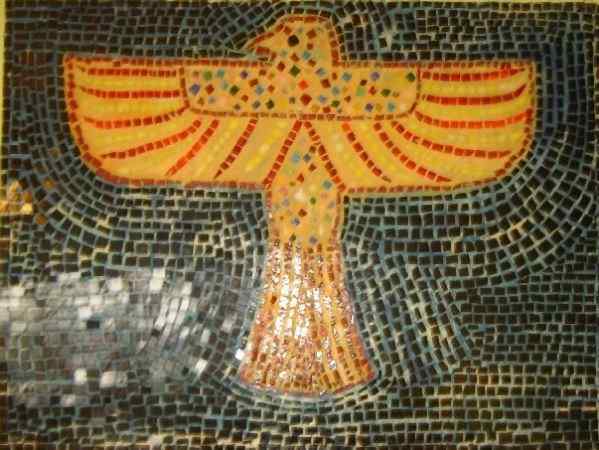
The "Aztec Eagle" is the example of how Carla Bertoli is able to represent, perfectly mastering the mosaic techniques, the sense of superposing volumes and using spaces,
letting the sparkling colours emerge and giving the one who observes the artwork a significant reading, as well as feelings and gut involvement, without detaching the strong tones in the composition.
All becomes harmony and transmits the ethics and aesthetics, thus contributing to state that today, an artwork is not a photographic homework but exalting the creation...
Immersing myself in the technical pictorial path of Carla Bertoli, I find a pleasing technical discovery: "Strolling Women 2" actually exalts composition and sinuosity;
it is a harmonic dance of the women who are marked - and not by chance - by three different colours, of "noble simplicity" reminiscent of Antonio Canova’s neoclassical sculptures...
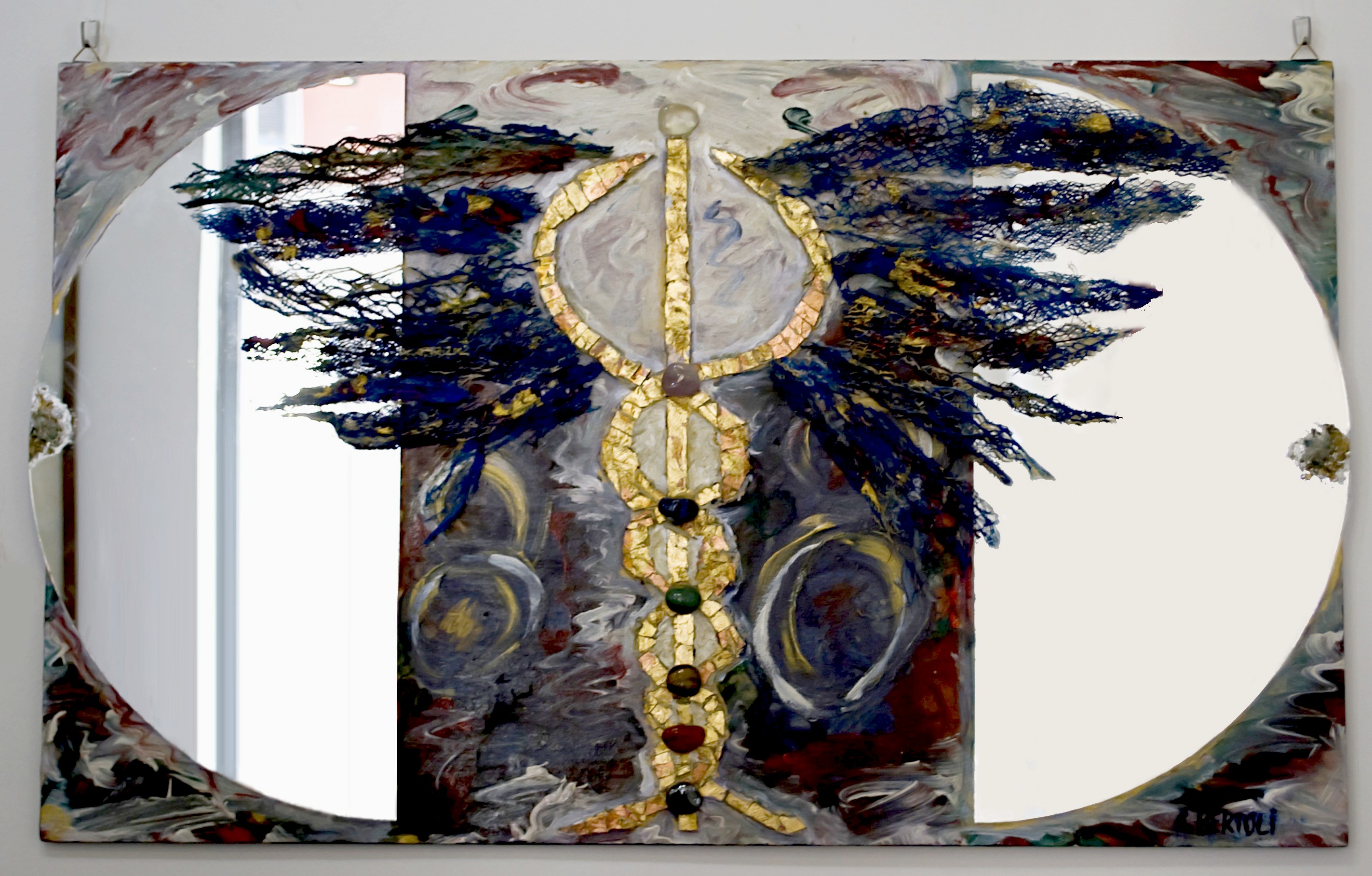
The caduceus is one of the most ancient symbols in human history: depictions of the caduceus have been found on a cup owned by the Mesopotamian King Guda, monarch of the town of Lagash;
the symbol was used also in ancient Egypt where on some burial monuments the god of the dead Anubis is shown holding a caduceus in his hands.
In this exceptionally beautiful work, Carla Bertoli shares her cultural and technical experience and succeeds in capturing the interest of the observer,
almost taking him in to share her emotions in an amalgam of a thousand feelings: a factory of emotions pervades and invades and the colours, although they might be light and fair at times, succeed in touching....
Moving forward on this path, I feel even more convinced of the great technical skills of this young artist, who seeks chromatic perfection:
the blue colour is an example of the great intimist intuition in the pictorial quest that characterizes Bertoli’s works...
During my stroll within the wide Italian art scenario I have eventually met a sweet and harmonious art, a full bodied, shining and reflecting substance that is also reflexive and slightly dreamy at the same time.
This is the artist’s way to express herself, an already mature Carla Bertoli; simple works, essential titles, where there is a need for attention to detail and a will to amaze, not banal works but simply self-sufficient,
simple and thus piercing and rich with visual instant impact.
Synthesis for sure, but also essence, appearing as an underlying theme turned towards the harmony of the universe where every visual hypocrisy or haughty or fake research is avoided,
letting the taste for transparency emerge, the honest and radiant feeling, where being overcomes the need of appearing...
Franca Valeria Oliveri
Click to zoom
Caduceus
Mixed technique 60 x 100 cm.
she comes third in the figurative art section
By Franca Valeria Oliveri
Group "X-Factor Painter selection competition"
20th April 2009
Representations of the caduceus, a stick with two snakes, has extremely ancient origins. It symbolizes peace, identifies the eternal dualism between illness and healing, between yin and yang, life and death.....
Carla’s interpretation is very interesting, it uses mineral shiny tiles to enhance this item clad in mysticism in a light... almost ethereal ... context, where the wings soar.